
President Trump Met With Delphi Retirees
- Details
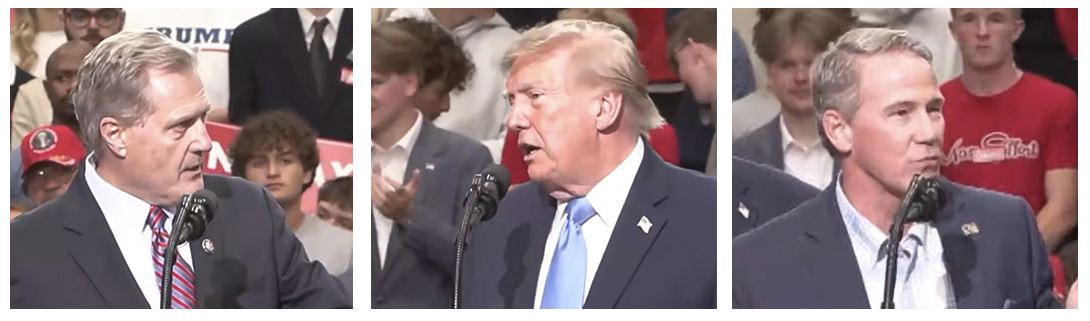
On October 3, Rep. Mike Turner (OH) arranged for a small group of Delphi salaried retirees to meet in Vandalia, Ohio, with President Trump, who was there to make a public appearance. The president wanted to meet with the retirees because Sen. Husted (OH) succeeded in getting a pension restoration amendment into the National Defense Authorization bill that's pending in the Senate.
Rep. Turner told reporters, "It's the first time that we're this close. We have the support of the White House, and the president wanted to meet with these retirees who have been impacted." Turner further explained that the president met with the Delphi contingent, heard their stories, and was impacted by them. He then took to the podium, and made a commitment to "get this done."

Congressional Intent Not Followed
- Details
CONGRESS SHOULD RESTORE FULL DELPHI SALARIED PENSIONS
In 1974 Congress passed the ERISA law that requires the Pension Benefit Guaranty Corporation (PBGC) to “encourage the continuation and maintenance of pension plans” AND “to provide for the timely and uninterrupted payments of benefits” 29 USC §1302.
35 years later, in 2009, the PBGC terminated the Delphi Salaried Retirement plan (DSRP) in an unprecedented circumstance that involved the financial affairs of another major U.S. corporation. It was driven by the U.S. Government buying most of the stock of that other corporation. The PBGC ignored its ERISA duties and stopped advocating for the retirees.
- In 2005 the former auto parts maker, Delphi Corporation, filed for bankruptcy. By early 2009, it was successfully working to reorganize. The PBGC was advocating for Delphi retirees -- as it should -- by a) allowing Delphi to make partial payments to the DSRP and b) placing liens on Delphi’s foreign assets to protect the retirees’ interest.
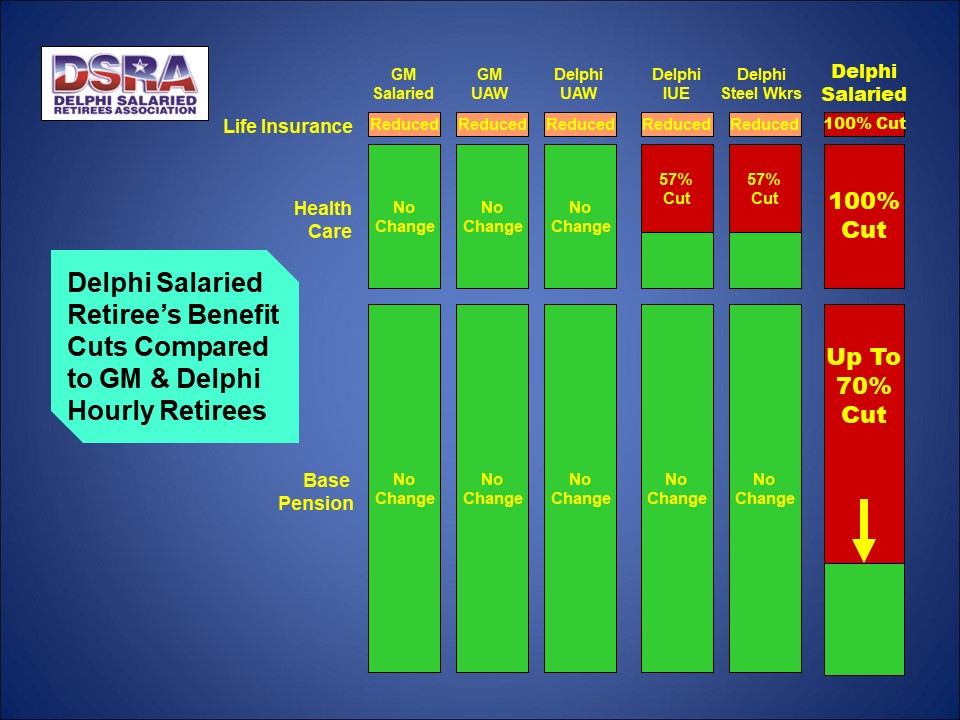
- But in early 2009, the DSRP got caught up in the Obama Administration’s efforts to save General Motors from financial collapse. The Government bought $50 billion in New GM stock as part of a 40-day, Government-led bankruptcy. But GM’s biggest supplier was Delphi, and the Government sought to accelerate Delphi’s emergence from bankruptcy, so the PBGC looked away and denied Delphi retirees up to 70% of their earned pensions!
- The lead Government official under U.S. Treasury said it advocated for the termination of Delphi’s pension plans (Feldman deposition extracts). This would hasten Delphi’s exit from bankruptcy, paving the way for the U.S. to buy New GM.
- Joseph House, the PBGC’s lead official in the matter, admitted in a Federal Court proceeding that the interactions between the PBGC and Treasury were unique (House Deposition excerpts) He separately noted that PBGC representatives invited to a court-ordered mediation of the Delphi bankruptcy instead “sat in a room and read books all day.” Following the mediation, those involved announced a global resolution of the Delphi bankruptcy that involved protecting the full pensions of union-represented Delphi retirees, but not those of salaried retirees. It’s unprecedented for the Executive Branch to be involved in the termination of a pension plan.
- The U.S. Treasury Secretary Geithner had conflicting interests because he was one of the PBGC’s three board members (with its mission to protect retirees). But he also wanted to protect the Government’s $50 billion investment in New GM (which pundits began calling “Government Motors”).
Importantly, the DSRP was historically well-funded and well-managed – unlike other terminated plans that were not.
- It was frozen by Delphi in 2008, and certified to be more than 85% funded in October of 2007 and 2008 (ref. Watson Wyatt certification). And despite the Great Recession, the DSRP’s funded status was above the average of the nation’s 100 largest pension plans (ref. Wells Fargo) in July of 2009.
Government Broke It
- Details
SUPPORT BIPARTISAN LEGISLATION
Our Government Broke a Viable Delphi Salaried Pension Plan (DSRP)
House and Senate bills H.R.1357, H.R.1895, S.1950 call for restoring a pension plan that was wrongfully terminated by the U.S. Government under the Obama administration.
A traditional Pension Benefit Guaranty Corporation (PBGC) pension termination occurs when the PBGC itself initiates the termination of a company’s failed pension plan. This termination was uniquely different.
This Would NOT Be a Bailout of a Troubled Pension Plan
The DSRP was traditionally well-funded and well-managed when terminated by the PBGC in mid-2009. According to a credentialed actuarial firm, it was more than 86% funded 10 months prior to termination. The DSRP’s funding status at that time was no worse than the vast majority of other similar pension plans whose valued assets had also plummeted temporarily because of the 2009 recession.
Restoring This Pension Plan Would NOT Set a Precedent for other Plans
Extraordinary circumstances surrounded the U.S. Government’s 2009 termination of the Delphi Salaried Retirement Plan (DSRP), unlike any other. The Government made an unprecedented decision in 2009 to intervene in the private GM bankruptcy. But GM’s biggest supplier, Delphi Corp., was working through the final steps of its own bankruptcy, so the Government interfered in that, too. After a rushed 40-day bankruptcy, the government’s influence on the PBGC resulted in GM salaried and hourly pensions being protected as well as most Delphi hourly pensions. But it was Delphi salaried retirees who were singled out for pension termination. This termination was uniquely different from every normal pension termination initiated by the PBGC. Government picked winners and losers!
Conclusion: The PBGC didn’t initiate the salaried plan’s termination because it was failing. It yielded to the Administration’s plan to rescue General Motors. Protecting these retirees took a back seat. Please see our “Congressional Intent” document with PBGC testimony showing how ERISA law was not followed, and the PBGC failed to protect retirees.
Sen. Husted Introduces Delphi Salaried Retirees Pension Bill
- Details
Sen. Husted Introduces Senate Bill S.1950.
WASHINGTON – Sens. Jon Husted (R-OH), Kirsten Gillibrand (D-NY), Bernie Moreno (R-OH) and Gary Peters (D-MI) introduced the Susan Muffley Act of 2025. Cosponsoring are Sen. Tammy Baldwin (D-WI), Sen. John Fetterman (D-PA), and Sen. Roger Wicker (R-MS). This bipartisan, bicameral bill would restore the pensions of more than 21,000 Delphi salaried retirees, including approximately 5,180 in Ohio.
“Delphi salaried retirees were robbed of their pensions and the stable retirement they worked hard for throughout their careers. It’s right and fair to ensure these workers—including more than 5,100 Ohioans—receive the pensions they earned,” said Husted.
Spartz Introduces Delphi Retirees Pension Restoration Act
- Details
Rep. Spartz Introduces Additional Bill for Restoration of Delphi Salaried Retirees’ Pensions
March 7, 2025
Congresswoman Victoria Spartz (IN-05) and 13 of her House colleagues introduced bipartisan legislation to fully restore retirement benefits of the Delphi retirees. – H.R.1895.
"This bill restores retirement benefits for thousands of hard-working Americans wronged by the politics of an auto-industry bailout in 2009 with no fiscal impact to the taxpayers," said Spartz."“This issue has not been resolved for too long, and I appreciate the bipartisan support to finally bring justice for so many people around the country."
Susan Muffley Act 2025 Introduced in the House
- Details
Rep. Turner Reintroduces Bill to Restore Delphi Salaried Retirees’ Pensions
February 13, 2025
WASHINGTON, D.C. – Today, Congressman Mike Turner (OH-10) joined representatives Marcy Kaptur (OH-09), Claudia Tenney (NY-24), and Gwen Moore (WI-04) to reintroduce the Susan Muffley Act of 2025 – H.R.1357.
This bipartisan effort is aimed at restoring pensions for over 21,000 Delphi Salaried Retirees, including approximately 5,180 in Ohio. Named in honor of the late wife of a Delphi retiree, the legislation seeks to provide financial relief to those whose pensions were reduced or eliminated following Delphi’s bankruptcy.
“I have remained steadfast in my fight to restore the pensions of Delphi Salaried Retirees,” said Congressman Mike Turner. “While this has been a long time coming, the strong bipartisan support gives us hope that we can finally right this wrong for those who lost their pensions.”
read full post ... Susan Muffley Act 2025 Introduced in the House